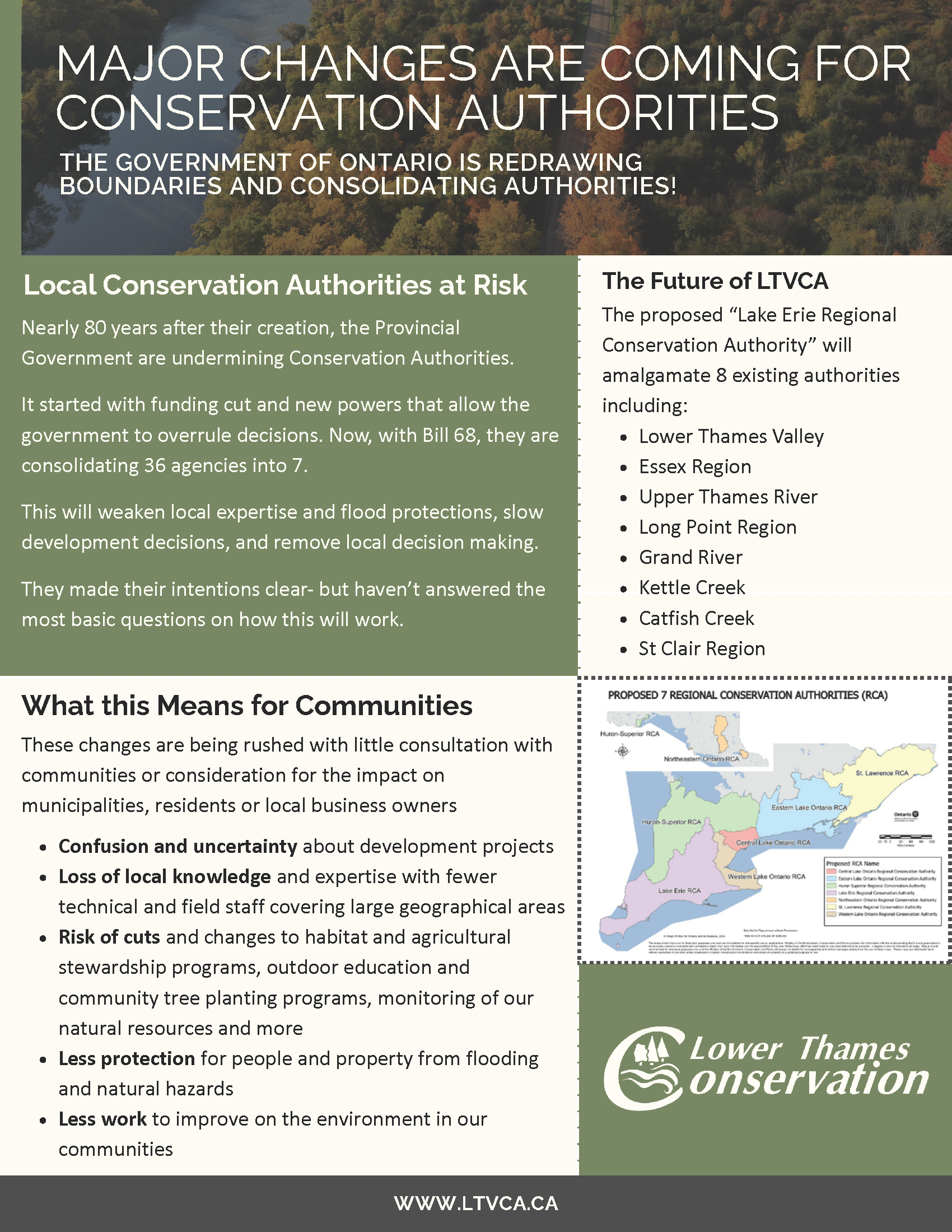
On November 20, 2025 the LTVCA held a special board meeting by request from the Chair. Its main point of discussion was the Province’s proposal to consolidate Ontario’s 36 Conservation Authorities into seven regional entities under Bill 68, Plan to Protect Ontario Act (Budget Measures), 2025. The plan, announced by Environment Minister Todd McCarthy on October 31, includes creating an Ontario Provincial Conservation Agency to oversee the amalgamation and consult on proposed boundaries.
The LTVCA Board had many concerns with the proposed boundary change, especially in regards to geographical size. The current LTVCA board has representation from all 10 member municipalities, however under the proposed boundaries the Lake Erie Regional Conservation Authority Board would represent and make decisions for 80 municipalities. The main concern was accountability from the Regional Conservation Authority to the local municipalities. Local service delivery is critical to maintaining on the ground services to builders, developers and residents. The creation of a huge regional conservation authority will not only decrease accountability but increase bureaucracy, costs and timelines for local communities.
The Provincial goals for consistent permit approval processes, shared services, and digital modernization can be realized by the current Conservation Authority structure without imposing a new top-down agency structure without strong local accountability and increased costs to taxpayers.
Following significant discussion regarding this proposal, the Board unanimously passed the following resolution, which states:
WHEREAS the Ministry of the Environment, Conservation and Parks has posted Environmental Registry Notice No. 025-1257 (“Proposed Boundaries for the Regional Consolidation of Ontario’s Conservation Authorities”), proposing to reduce Ontario’s 36 conservation authorities to 7 regional entities as part of a broader restructuring that would also create a new Ontario Provincial Conservation Agency to provide centralized oversight and direction under the Conservation Authorities Act; and
WHEREAS under this proposal, the Lower Thames Valley Conservation Authority (LTVCA) would be merged into a new “Lake Erie Regional Conservation Authority” together with the:
Essex Region CA
St. Clair Region CA
Upper Thames River CA
Kettle Creek CA
Catfish Creek CA
Long Point Region CA
Grand River CA
forming a single organization stretching from Windsor, London and Sarnia, through to Waterloo region; and
WHEREAS the Board acknowledges and supports the Province’s goals of improved efficiency, consistency and fiscal prudence in conservation delivery, but finds that the proposed “Lake Erie Region” configuration would:
- Create a geographically vast and administratively complex entity, joining south western rural and urban municipalities throughout the province with little shared watershed connection or economic alignment;
- Dilute local accountability and municipal partnership, contrary to the principle that decisions are best made closest to the communities they affect;
- Generate substantial transition costs — including human-resources integration, governance restructuring, IT migration and policy harmonization — that would divert resources from front-line service delivery and delay measurable outcomes, contrary to the Province’s own business-planning principles of value for money, cost containment and service continuity; and,
- Risk greater uncertainty and delay for builders, developers and farmers, as local permitting offices and staff familiar with site conditions are replaced by distant regional structures, making it harder for applicants to obtain timely on the ground local advice, resolve issues or expedite housing and infrastructure approvals that support the Province’s “Get It Done” agenda; and
WHEREAS the LTVCA has already undertaken significant modernization work aligned with provincial objectives, including:
- Implementation of a Customer Service Delivery Program;
- Continually improvement of delivery standard well above the standard required by the province – 2024 – 81.7% met standard, 2025 – 96.8% are meeting standard
- Continual improvements in transparency and client communication through a number of recent strategic planning initiatives;
- Improvement in data and network systems, including security and redundancy
- Maintenance of a very low administrative overhead cost (e.g.10.7% (2024) of total operating costs).
And has done this while retaining in person local support to developers and permit recipients and
Maintained a very limited levy increase to municipalities over the last 8 years.
This demonstrates that cost effective and meaningful modernization can occur within the current watershed-based governance framework; and
WHEREAS the Board further recognizes that the Lower Thames Valley Conservation Authority serves Southwestern Ontario communities facing vastly different climatic, hydrological and infrastructure realities (e.g. large diking and pumped systems) based on the needs of vibrant rural and urban communities that are very different than the large urban communities found in the proposed regional conservation authority,
THEREFORE BE IT RESOLVED THAT:
The Board of Directors does not support the proposed “Lake Erie Regional Conservation Authority” boundary configuration outlined in Environmental Registry Notice 025-1257; and
The Board instead endorses further provincial evaluation of a more focused specific model as a geographically coherent, cost-effective and locally accountable alternative that advances the government’s priorities of efficiency, red-tape reduction and timely housing delivery; and
The Board requests that the Ministry engage directly with affected municipalities and conservation authorities across Southwestern Ontario most specifically, the Lower Thames Valley municipalities before finalizing any consolidation boundaries or legislative amendments.
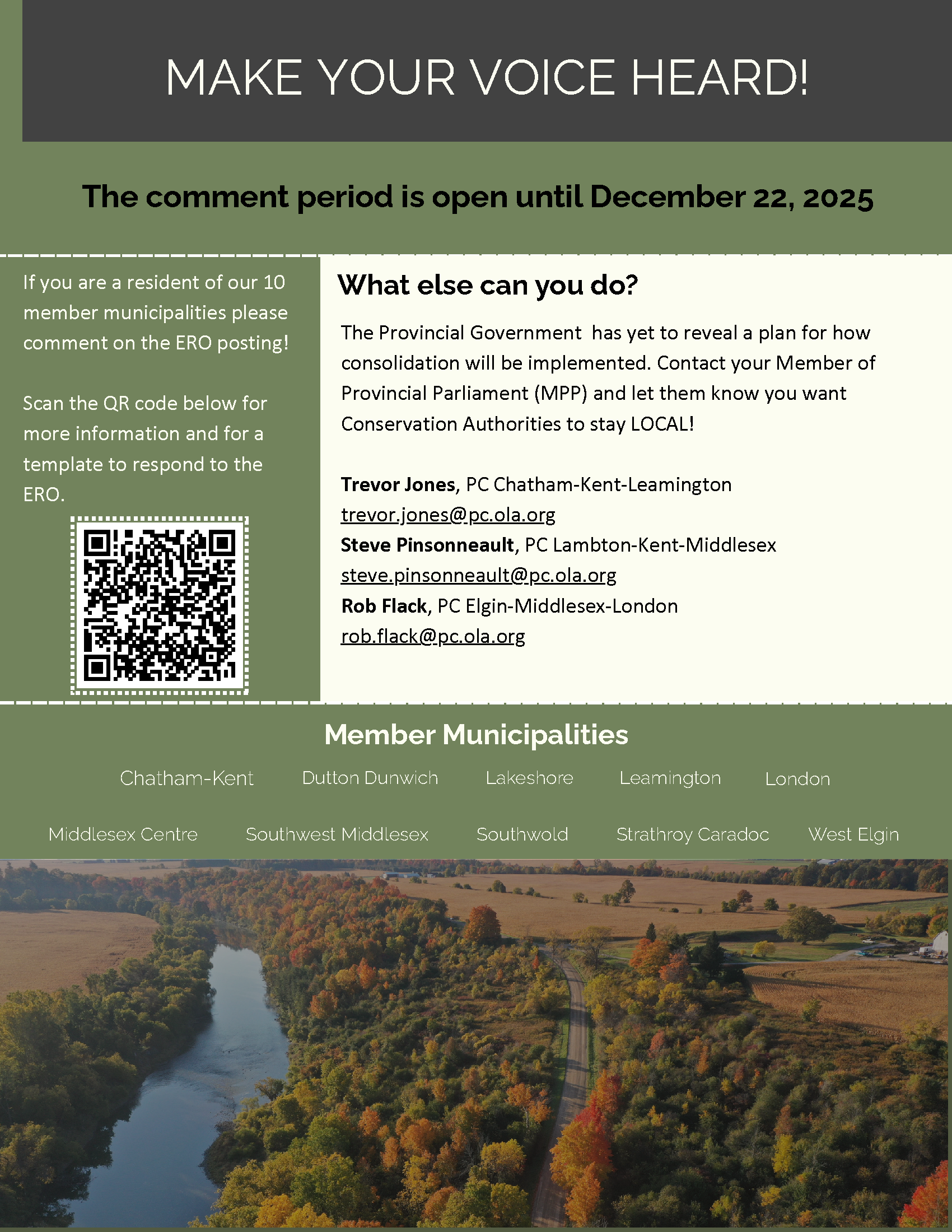
The Environmental Registry of Ontario (ERO #025-1257) is open for public comment until December 22, 2025. This is your opportunity to speak up. Tell the province that conservation decisions must remain local, accountable, and responsive.
Submit your comments today at ero.ontario.ca/notice/025-1257.
Contact your local MPP to urge them to pause and keep local watershed management decisions in the hands of local decision-makers. If you need assistance in commenting on the ERO #025-1257, please use the file below to aid in generating a response.
Conservation Authority Consolidation Information Poster